
Closed-cell foam insulation in Windsor CA - sealed and insulated where space is tight
Cold floors, a hot room under a low roof or a damp crawl space? Closed-cell foam seals and insulates it in one layer.
- Licensed and insured.
- Free quotes on site.
- We reply within 1 business day.
Is closed-cell foam the right insulation for your Windsor house?
The short answer: Closed-cell foam insulation is a dense spray foam that sets up hard and seals air leaks while it insulates. In Windsor, CA, we use it where there's little room for insulation or where damp is a problem, like a cathedral ceiling, a low roof over a bonus room or a crawl space.
Most people who call me have cold floors, a room over the garage that never feels right, or an attic they've never looked in. Closed-cell foam costs more than other insulation, so the price mostly comes down to how many square feet we cover and how thick it has to go, plus whether wet or dirty old insulation has to come out first and how hard the space is to reach. The schedule turns on that prep and on finding a stretch when everyone in the house can be away, and you'll have a written estimate once I've seen the space. Sometimes the better first step is attic air sealing and a top-up, and if that's true for your house I'll say so.
How do you know closed-cell foam might fix the problem?
Cold floors over the crawl space
If the floors are cold underfoot all winter, the usual cause is outside air coming in at the rim joists and through gaps in the subfloor, with thin or sagging insulation below. The longer it goes, the more you pay to heat a house that leaks from the bottom up.
Hot room under a low roof
A bonus room, a room over the garage or a vaulted ceiling that bakes in summer usually means the rafter space is too shallow for enough batts or loose fill. It won't damage the house, but that room stays one you avoid half the year.
Musty smell or damp insulation
A musty crawl space, damp batts hanging off the floor framing or rusty nail tips in the attic usually mean moist air is reaching cold wood. Left alone, wet insulation stops doing its job and the framing it touches can start to rot.
How we install closed-cell foam insulation
I start by working out whether closed-cell is the right call, because it makes sense where space is tight or water's a worry, and when a cheaper option would do the job I'll tell you plainly. In an attic, sealing the gaps and topping up loose fill usually wins unless your ductwork runs up there. Before we spray, I walk your household through the time away from home. Then our crew pulls out any old insulation that's soaked or full of droppings, because foam over a mess just seals the mess in. We mask off what shouldn't get foam and spray in layers to the depth the space needs. At the rim joists, the band of framing that sits on the foundation, one pass stops the draft and insulates at the same time. When the foam has set, we trim it, check the edges and corners, since thin coverage at the edges is where these jobs usually come up short, and clean up.
Some jobs call for a different foam or a different kind of building. Open-cell foam insulation is softer and usually costs less, so it often fits deeper walls and attics where moisture isn't a concern. For shops, offices and other business buildings, we handle commercial insulation with the same look-first approach.
Roof decks and cathedral ceilings
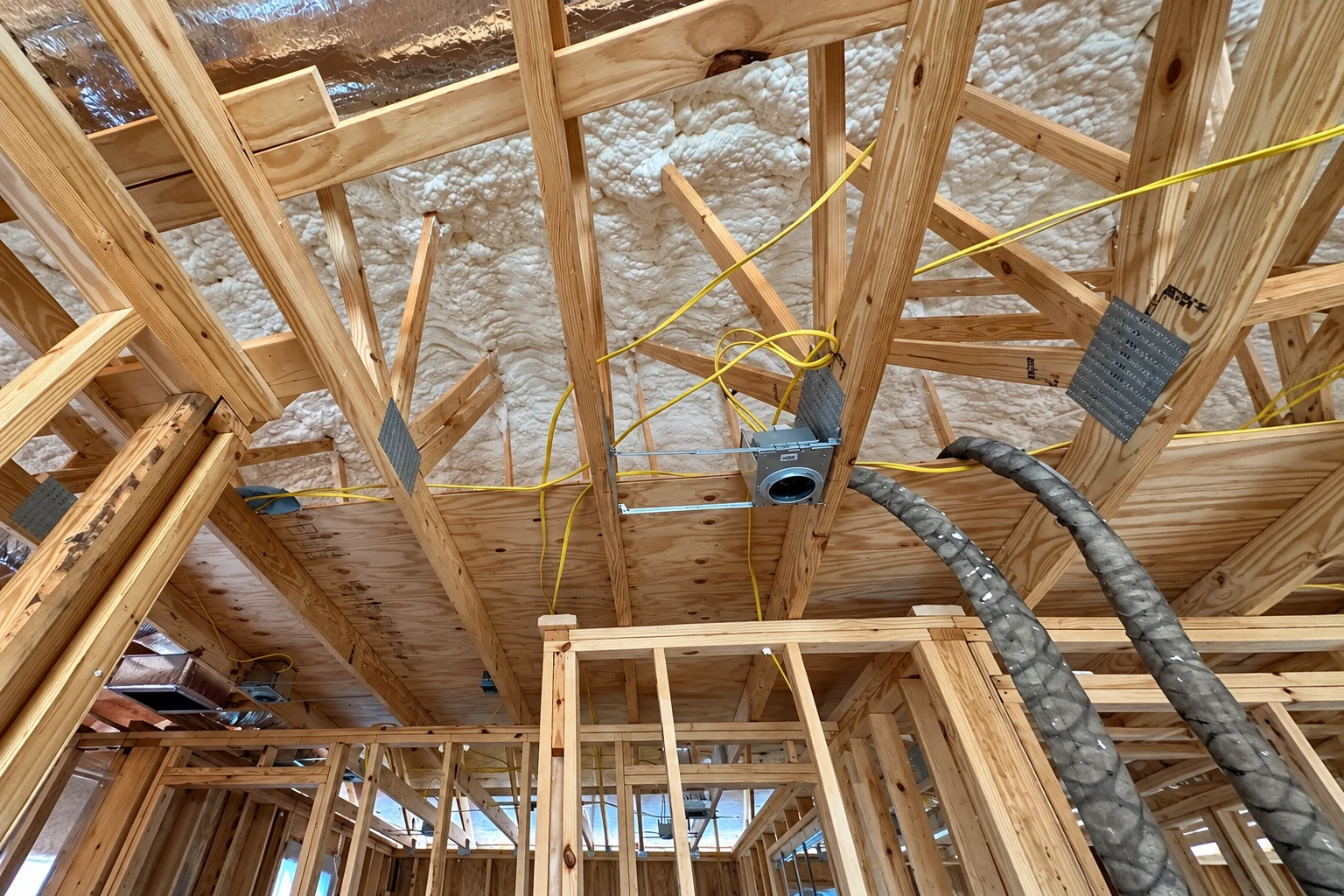
This suits a vaulted ceiling, a bonus room tucked under the roof or an attic you want inside the warm part of the house, because foam fits more insulation into a thin rafter space than batts can. It's also the case where your ductwork lives up there and you'd rather it sit somewhere that isn't baking or freezing.
Crawl spaces and rim joists
This suits a house with cold floors over a low or damp crawl space, because closed-cell holds up where moisture is around and seals the leaky rim in the same visit. If your crawl space is dry and easy to move around in, I may point you to a cheaper way to do it.
What happens when you call about closed-cell foam in Windsor?
There are three steps, and I'm the one you'll see at the start. I'd rather explain the order of the work before anyone sprays anything, because a job done in the wrong order wastes money.
- Step 01
Call or send a request
Call (707) 687-4455 or use the form, and we'll set a time for me to come out. It helps to have the area you want insulated, its rough size and any health concerns in the house, like asthma, ready to tell us.
- Step 02
I look and explain first
I go through the attic or crawl space with you, show you what I find and tell you what has to be fixed first. Then you get a written estimate, so you know the price before any work is booked.
- Step 03
Our crew does the work
Our install crew does the job with a lead installer on site, and we handle the permit side if your job needs one. Windsor allows construction from 7 a.m. to 7 p.m. on weekdays and 8 a.m. to 7 p.m. on Saturday, with Sunday work only by approval from the Building Official, so we plan your time away around those hours.
Closed-cell foam insulation jobs in Windsor, CA
The Town of Windsor Building Division enforces the state building code and the city's own code, and it's the office that decides whether a given job needs a permit. I look at that for your house at the estimate, and if a permit is needed, we take care of the application and set up the inspections. The Building Division's rule of thumb is that anything you cover up or make hard to reach needs an inspection first. Spray foam buries whatever it's sprayed over, so on a permitted job we line up any inspection before the foam goes on.
What I see most around here are older houses with shallow rafters under low roofs, and crawl spaces that stay damp through our wet winters, which are the spots where closed-cell earns its higher price. We see the same thing on jobs in Santa Rosa and Healdsburg.
Get a free on-site estimate for closed-cell foam
We reply within one business day to set up a free visit, and there's no obligation. I come out, look at the space with you and follow up with a written estimate.
Why Windsor homeowners call H&M Windsor Spray Foam Insulation
The owner looks before quoting
I come out myself to look at the house and write the estimate, and I explain what I find before I suggest anything. When you understand your own house, it's a lot easier to judge whether foam is worth the money.
Small on purpose since 2017
We started in 2017 and have kept the business small, with a lead installer on site running each job. You know who's working in your house and who to ask when something looks off.
Licensed and insured in California
We're licensed and insured. California's C-2 insulation classification covers contractors who install insulation for heat or sound control, so it's the license worth asking any insulation contractor about.
With foam, the money is well spent only if it goes on the right part of the house first. Request an estimate or call (707) 687-4455, and I'll come take a look.
Closed-cell foam questions from Windsor homeowners
How much does closed-cell spray foam insulation cost near Windsor?
Closed-cell spray foam in nearby Santa Rosa usually costs about $1 to $1.60 per board foot, which is one square foot of foam one inch thick. That's what the work typically runs in the area, not our price, and your own figure comes in the written estimate after I've seen the space.
How long do we have to be out of the house for spray foam insulation?
Plan to be out of the house while the foam goes in and for at least 24 hours afterward, which is what Consumer Product Safety Commission staff recommend. The same staff suggest talking through the contractor's safety steps before work starts, so we go over the time away with your whole household, kids and pets included, and you can line up somewhere to stay.
What is the best way to insulate a cathedral ceiling?
Closed-cell foam is usually the strongest choice for a cathedral ceiling, because it gets the most insulation out of a thin rafter space and works in a roof that isn't vented. The same goes for an attic you want to leave unvented. If your rafters are deep, I'll tell you whether something cheaper would do the job.
Is spray foam insulation safe for someone with asthma?
If someone in your house has asthma, respiratory allergies, a skin condition or a past reaction to isocyanates, the chemicals spray foam is made from, the same federal safety staff advise reading the product information carefully before the job. If it's still a worry, they suggest considering another kind of insulation, so tell me at the estimate and we'll talk through your choices.
How much can an insulation contractor ask for up front in California?
Under California's contractor rules, a down payment can't be more than $1,000, and on smaller contracts the limit is lower still. Any other payments have to be spelled out in the contract and tied to work already done or materials already delivered to your house.
Does closed-cell foam absorb water in a crawl space?
No, closed-cell foam doesn't absorb water, so it won't soak up moisture once it's in place. At its usual thickness it also slows moisture vapor to almost nothing, which is why it fits damp crawl spaces and the rim joists above them. It won't fix a leak, though, so I'll point out where any water is coming from so that gets fixed first.
Related insulation services in Windsor
Open-cell foam insulation
If your walls or attic have room for a thicker layer and moisture isn't the worry, open-cell foam seals air well and usually costs less.
Commercial insulation
Shops, offices and other business buildings with drafty work areas, hot upper floors or damp spaces get the same look-first visit before we recommend any insulation.
Book your closed-cell foam estimate
Call (707) 687-4455 any day of the week, since we answer until 10 PM on weekdays and 9 PM on weekends, or send a request through the form.