Commercial insulation in Windsor CA - roofs and walls built to state energy rules
A building that won't hold its temperature, or a reroof on the calendar? We plan your insulation to fit state energy rules from the start.
- Licensed and insured.
- Free quotes on site.
- We reply within 1 business day.
What does commercial insulation involve for a Windsor business building?
The short answer: Commercial insulation in Windsor, CA adds insulation to a business building's roof and walls so the space holds its temperature. Putting the right layer in the right spot is what lets a reroof or wall upgrade pass California's Energy Code.
Most owners and property managers who call us have a reroof coming, a space being fixed up for a new tenant, or rooms that never feel right, and they want to know what the state will require before they commit. The price moves with the roof and wall area, the framing, which products go in and whether old material has to come out first through insulation removal. The schedule turns on your roofer's timeline and whether the job needs a permit and inspections. I'll give you the figure for your building in a written estimate after I've seen it.
How do you know your building needs better insulation?
A reroof on the calendar
If a roofer already has a date on the books, that's the easiest moment to deal with insulation, because the roof is open anyway. If you wait until after, adding it later can mean opening finished work a second time.
Rooms that won't hold temperature
Offices or back rooms that run hot or cold while the rest of the building is fine usually point to thin or missing insulation, or gaps letting outside air through. Left alone, the heating and cooling keeps working harder to hold the same space.
Water beading on metal walls
Moisture on the inside of metal wall or roof panels usually means warm, damp air is reaching cold metal with nothing in between. Over time that water can stain finishes, rust fasteners and soak whatever insulation is already there.
How we handle commercial insulation
On a business building I start with the size of the job, because that tells me which state energy rules it brings in, and then I build the plan around them. I walk the roof and walls with you, check the framing and look at what's already there, including anything soaked or damaged that has to come out before new material goes over it. Our crew seals the gaps around pipes, conduit and roof openings first, so the new layer isn't fighting a draft, and then installs it evenly out to the edges instead of piling it deep in the middle. Every product we'll use goes on the estimate by name, so you can lay our bid next to anyone else's and compare them side by side.
Moisture is often part of the same job. On buildings that sit over a crawl space, we can add a crawl space vapor barrier so ground moisture doesn't work its way up into the floor and the new insulation. Where walls or ceilings are open, I'll also check whether vapor barrier installation belongs in the plan, because damp air trapped on the wrong side of insulation ends up in the framing.
Insulation with a reroof
This suits owners already replacing a roof, because the insulation goes in while everything is open and nothing gets torn up twice. When the reroof is big enough to bring in state rules, we size the layer to meet them.
Closed-cell spray foam
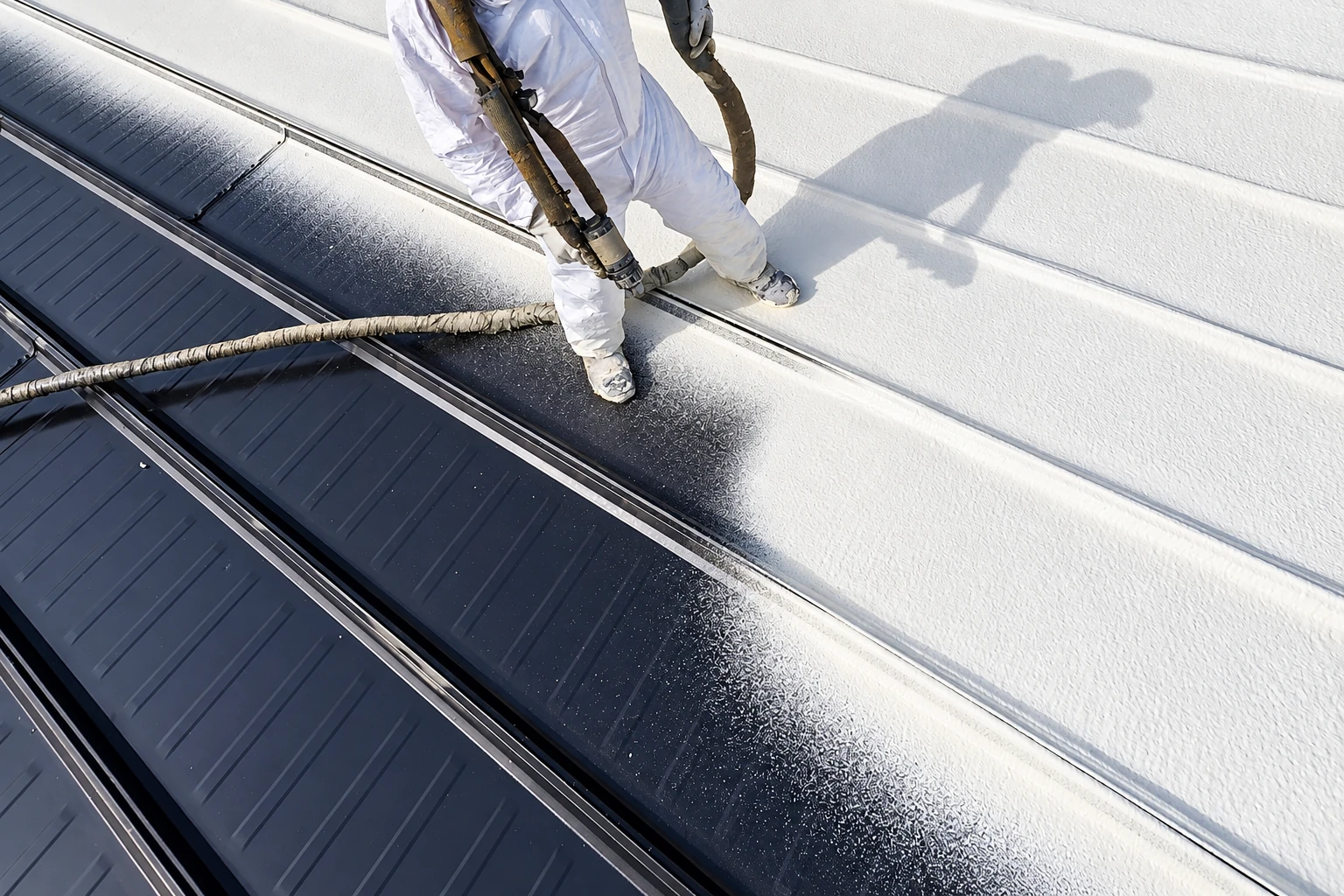
Closed-cell foam, a dense foam that also blocks moisture, suits metal buildings and spaces where ducts or equipment sit above the ceiling. It costs more, but it seals air while it insulates, which is worth it where leaks are hard to reach any other way.
Air sealing plus batts or loose fill
For most other ceilings and walls, sealing the gaps and then adding batts or blown-in fill, loose insulation blown through a hose, usually gives the best value. I'd pick this over foam unless ducts run through that space.
What happens after you call about commercial insulation in Windsor?
Here's how a commercial job runs from your first call to the last inspection, and who you'll be dealing with at each stage, so you can plan your building's schedule around it.
- Step 01
Tell us about your building
Call or send a request with the building type, the roof or wall area and the dates you have in mind. We'll set a time for me to come out and see it.
- Step 02
Walk the building with me
I look at the roof, walls and framing with you and explain what I find and what has to be fixed first. You then get a written estimate with the scope, the products and the price, so the cost is clear before anything is booked.
- Step 03
Our crew does the work
Our install crew does the work with a lead installer on site, inside Windsor's construction hours of 7 a.m. to 7 p.m. on weekdays and 8 a.m. to 7 p.m. on Saturday. Sunday work needs express approval from the town's Building Official, so we plan the job around weekdays.
- Step 04
Inspections and final walk-through
When the job has a permit, we set the schedule so inspections land Monday through Thursday, the days the town holds them. Once the work is done, the lead installer walks it with you before the crew packs up.
Commercial insulation permits and buildings in Windsor
In Windsor, the Town of Windsor Building Division enforces the state building code and the town's own code, and all building permits are applied for online through the town's eTRAKiT system. Whether your insulation job needs a permit depends on its scope, so I'll talk it through with you at the estimate. When it does, we take care of the application and set up the inspections, so you aren't learning a permit system on top of running a business.
We're based in Windsor and work across Santa Rosa, Healdsburg and the other cities around it, where the business buildings we see run from older wood-framed storefronts to metal shop buildings. The framing changes the plan more than most owners expect, so I check it on every walk-through.
Get a written insulation plan for your building
Send the form and we'll reply within one business day to set up a free estimate on site, with no obligation. I'll come out, walk the building with you and follow up with a written estimate.
Why Windsor business owners call H&M Windsor Spray Foam Insulation
The owner writes every estimate
I come out myself to look at the building and write the estimate, and our install crew works with a lead installer on site. You talk to the person who made the plan, not someone reading it for the first time.
Explaining the job since 2017
We've been in business since 2017 and kept it small on purpose, so I can explain the work before we do it. Insulation done in the wrong order wastes money, and you should know why each step comes where it does.
Licensed, insured, satisfaction guaranteed
We're licensed and insured, which is the first thing worth checking on any bid for your building. Satisfaction guaranteed.
Scheduled around Windsor's rules
I set the crew's dates against the town's work hours and inspection days before we book anything. That keeps a permitted job moving instead of sitting idle while it waits for an inspection.
Start with a walk-through, because the size of your job decides which rules apply and how the plan comes together. Request an estimate or call (707) 687-4455.
Commercial insulation questions from Windsor owners
How much does commercial insulation cost in Windsor, CA?
There's no fair number until I've walked the building, because the price turns on the roof and wall area, the framing, the products and whether old material has to come out first. A job that brings in state energy rules, like a larger reroof, usually means more material and more planning than a small repair. Your written estimate gives you the figure for your building.
When do California Energy Code roof rules apply to a commercial reroof?
They apply when a nonresidential reroof changes 50 percent or more of the roof area, or more than 2,000 square feet, whichever is less. Small repairs fall outside those rules, so the size of your roof job decides how much the code shapes the plan. I measure that first, because everything else follows from it.
Which license covers insulation work in California?
California's insulation and acoustical contractor classification covers installing any insulating material for temperature or sound control. It's worth asking every bidder which license classifications they hold before you sign. If old material might contain asbestos, ask about that certification too, because a certified contractor can only do asbestos work within the license classes it already holds.
What is the best way to insulate metal-framed walls in a commercial building?
Metal-framed walls with insulation between the studs may need an added layer of continuous insulation, a layer that runs unbroken over the framing, to meet California's Energy Code. Metal carries heat right past insulation tucked between the studs, so plan on that extra layer as part of a wall upgrade. I check the framing at the walk-through so it's in the estimate from the start.
How do I compare commercial insulation bids in California?
Ask that every insulation product listed in each bid is certified by the California Department of Consumer Affairs, because state energy guidance only allows certified insulating materials. Then compare the bids product by product, not just by the total, since two bids at the same price can be for very different materials.
Does fiberglass insulation need air sealing in a commercial building?
One insulation company says it does, because fiberglass does a poor job of stopping air leaks and performs better when it's paired with an air barrier. Air moving through gaps carries heat straight through loose material, so I'll show you where your building leaks before we settle on what goes in.
Moisture work that often goes with commercial insulation
Crawl space vapor barrier
Many older storefronts and offices sit over a crawl space, and a vapor barrier on the ground slows damp air from rising into the floor above.
Vapor barrier installation
When walls or ceilings are open for new insulation, adding a vapor barrier on the right side helps keep moisture out of the framing and new material.
Book a walk-through of your building
Call (707) 687-4455, weekdays 8 AM to 10 PM or weekends 7 AM to 9 PM, with the building type, roof or wall area and the dates you have in mind so I come out ready.